
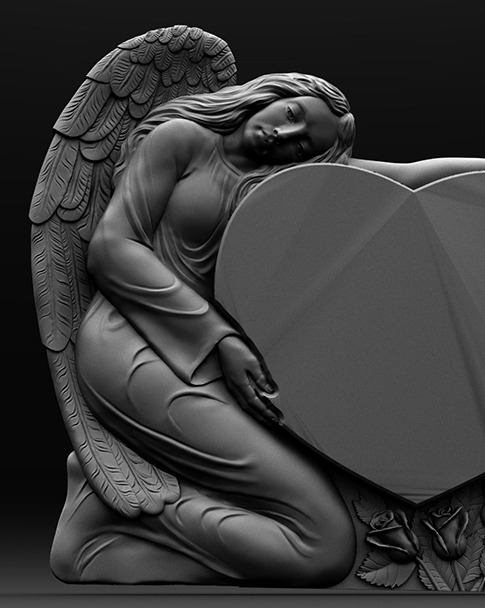

When choosing a CNC stone carving machine, many buyers focus first on the number of axes. But the more useful question is: What stone products do you need to make?
A 3-axis CNC machine, 4-axis CNC machine, and 5-axis CNC machine use different motion configurations, which directly affects how the cutting or carving tool can approach the stone. Understanding this difference can help you match the machine to your actual products instead of simply choosing the machine with the most axes.
From tombstone lettering and flat reliefs to columns, balusters, statues, and complex 3D stone sculptures, each axis configuration has its own typical application range.
1. What Does “Axis” Mean on a CNC Stone Machine?
Before comparing machines, it helps to understand what the axes actually control.
A standard 3-axis CNC stone carving machine moves along three linear directions:
A 4-axis machine adds a rotary axis, allowing the workpiece or tool to rotate during machining.
A 5-axis machine adds another rotational movement, allowing the cutting head to approach the stone from different directions and work on more complex surfaces.
2. What Can a 3-Axis CNC Stone Machine Make?
Typical configuration: X + Y + Z
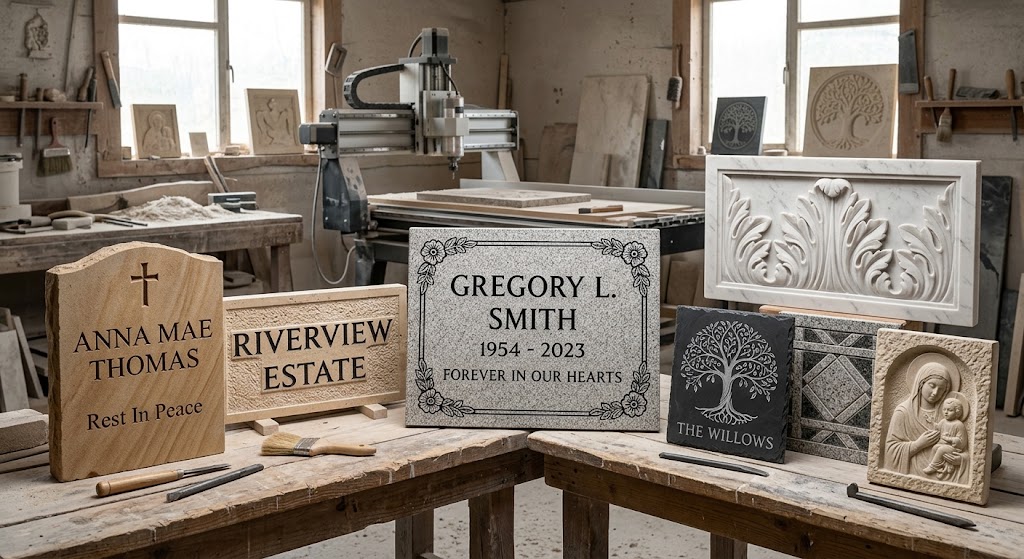
A 3-axis CNC stone carving machine is mainly designed for flat, 2D and 2.5D stone work. The stone remains fixed on the working table while the spindle moves across the surface according to the programmed toolpath.
Common applications
A 3-axis machine can be used for:
For example, a tombstone with engraved names, dates, borders and decorative patterns can usually be produced efficiently with a 3-axis machine. The same applies to a decorative stone wall panel where the design is primarily carved into one flat surface.
Where does a 3-axis machine become limited?
The main limitation appears when the product requires machining around a curved or cylindrical surface. Typical examples include:
This doesn't mean a 3-axis machine cannot produce any 3D effect. 2.5D relief carving is still possible, where different Z depths create raised and recessed areas on a relatively flat surface.
3. What Can a 4-Axis CNC Stone Machine Make?
Typical configuration: X + Y + Z + rotary axis
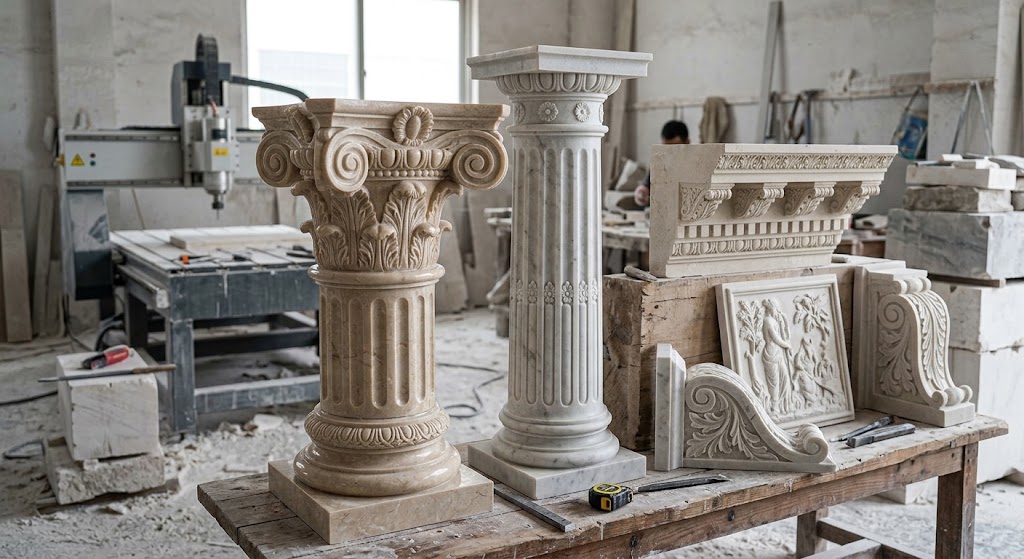
A Professional 4-axis CNC machine adds a rotary axis to the basic XYZ movement. This becomes particularly useful when the workpiece itself is cylindrical or requires machining around multiple sides.
Typical stone products
A 4-axis machine is commonly suitable for:
Imagine a stone column. With a conventional flat-table setup, the operator would need to reposition the workpiece repeatedly to machine different sides.
With a rotary axis, the workpiece can rotate during machining, allowing the toolpath to cover the circumference.
This is one reason a 4-axis configuration is useful for businesses producing columns, balusters and other rotational stone products.
What about small sculptures?
A 4-axis machine can also handle certain relatively simple round or rotational sculptures.
For example, depending on the machine configuration and CAM strategy, it may be used for some:
However, complicated sculptures with deep undercuts or surfaces that require the cutting tool to tilt in multiple directions may require a 5-axis configuration.
4. What Can a 5-Axis CNC Stone Machine Make?
Typical configuration: X + Y + Z + two rotary movements
A Advanced 5-axis carving machine adds additional rotational movement to the three linear axes.
The key advantage is not simply “more axes.” It is that the cutting tool can approach complex surfaces from different angles.
This makes 5-axis machining suitable for more complicated 3D stone products.
Typical applications
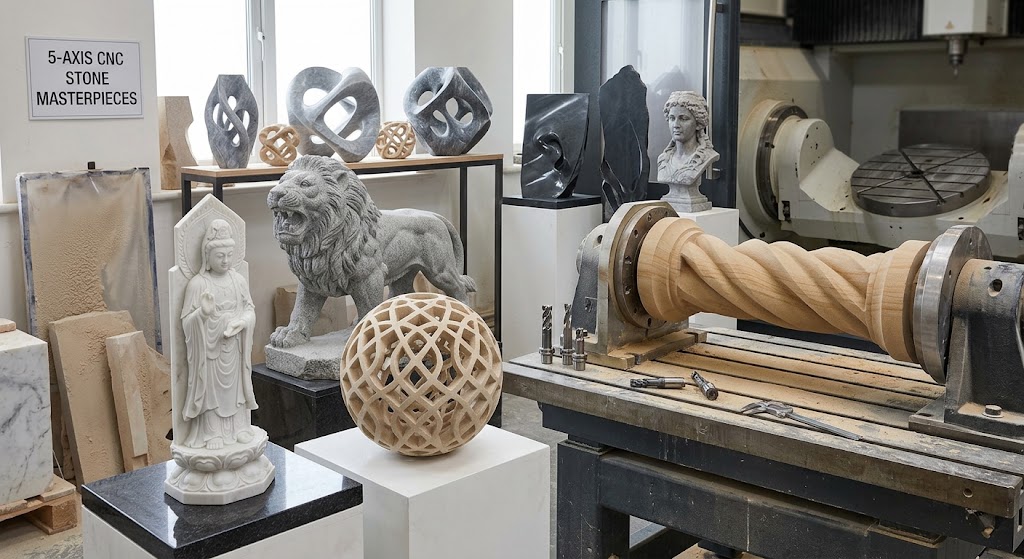
A 5-axis CNC stone machine can be used for:
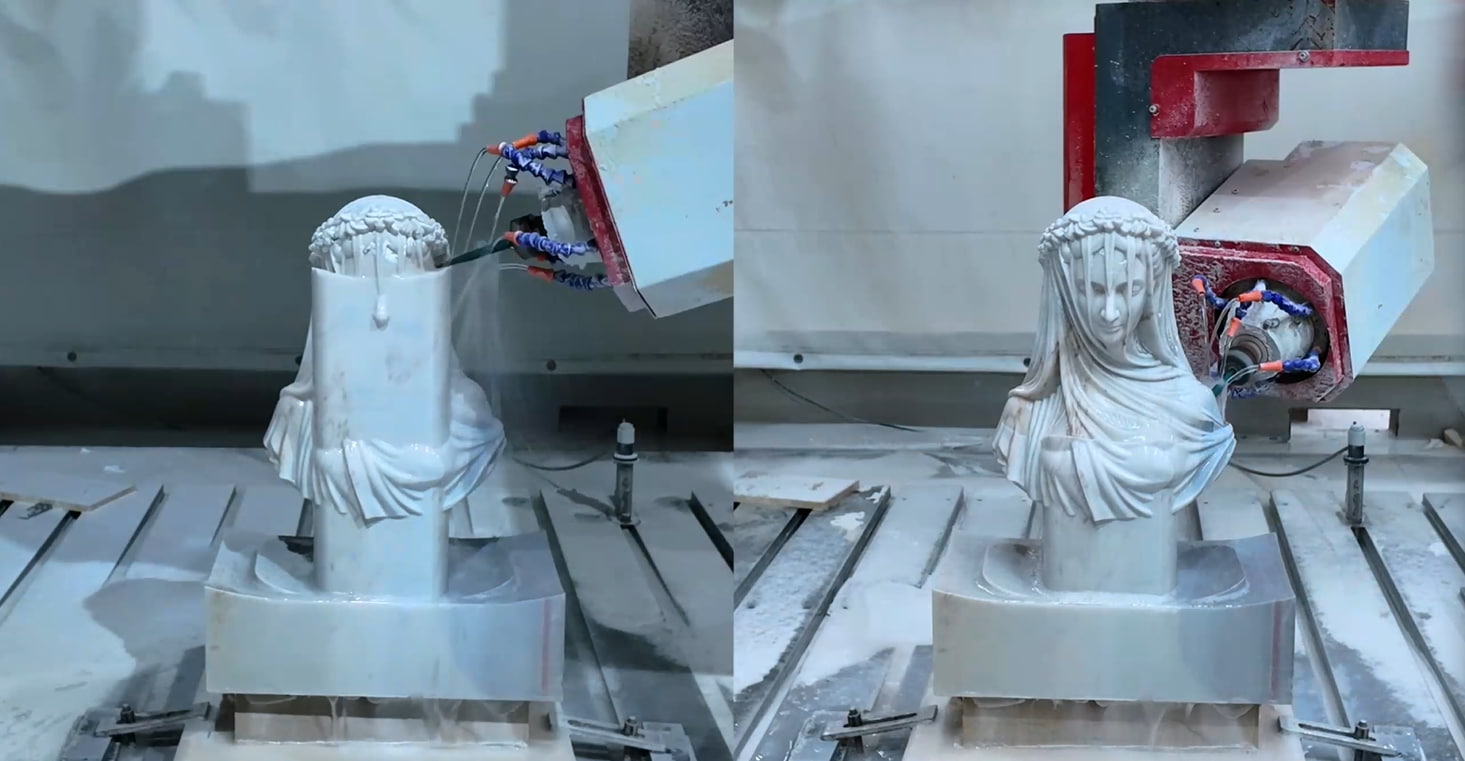
For a complicated statue, for example, the tool may need to reach the front, side, back and recessed areas of the model. A 5-axis machine can change the tool orientation while machining, reducing the need to repeatedly reposition the stone.
5. 3-Axis vs 4-Axis vs 5-Axis: What Is the Difference?
Here is a simple comparison you can use when planning a stone-processing business:
| Item | 3-Axis CNC | 4-Axis CNC | 5-Axis CNC |
|---|---|---|---|
| Basic movement | X + Y + Z | X + Y + Z + rotary axis | X + Y + Z + two rotary movements |
| Flat engraving | Yes | Yes | Yes |
| Stone lettering | Yes | Yes | Yes |
| Tombstone lettering | Yes | Yes | Yes |
| Flat relief carving | Yes | Yes | Yes |
| Decorative wall panels | Yes | Yes | Yes |
| Cylindrical carving | Limited | Yes | Yes |
| Roman columns | Limited | Yes | Yes |
| Stair balusters | Limited | Yes | Yes |
| Vases | Limited | Yes | Yes |
| Dragon columns | Limited | Yes | Yes |
| Simple round carving | Limited | Yes | Yes |
| Complex 3D sculpture | Limited | Limited | Yes |
| Hollow carving | Generally limited | Limited | Suitable for appropriate models |
| Complex curved surfaces | Limited | Limited | Yes |
| Deep undercuts | Limited | Limited | More suitable |
| Typical focus | Flat & relief work | Rotational & cylindrical work | Complex 3D work |
Important: The exact capability also depends on the machine's mechanical structure, spindle, rotary-axis configuration, tool length, working range, CAM software and the geometry of the specific product.
6. Think About the Product, Not Just the Number of Axes
A common mistake is to assume: More axes = better machine.
A better way to think about it is: More axes = more machining possibilities, but also more investment and more complexity.
The right configuration therefore depends on the shape, size, material and production volume of your products.
7. Match the Machine to Your Stone Products
A simple way to start is to classify your products by geometry.
If your products are mainly flat: Tombstones → plaques → lettering → wall panels → flat reliefs ; Consider a 3-axis CNC stone carving machine.
If your products are mainly cylindrical: Columns → balusters → vases → dragon columns → rotational ornaments ;Consider a 4-axis CNC stone carving machine with a rotary axis.
If your products contain complex 3D geometry: Statues → human figures → animals → hollow sculptures → complicated curved components;Consider a 5-axis CNC stone carving machine.
This product-based approach is usually more useful than starting with the question, “How many axes should I buy?”
8. Can a 5-Axis Machine Replace a 3-Axis or 4-Axis Machine?
In terms of machining capability, a 5-axis machine can generally perform many operations that are also possible on 3-axis and 4-axis equipment. But that doesn't automatically mean every workshop should use a 5-axis machine for every job.
For simple lettering or flat relief carving, the additional rotary movements may not provide a meaningful production advantage.
There are also other factors to consider:
For a workshop whose products are mostly flat, buying a machine designed around those requirements may be more appropriate than paying for capabilities that are rarely used.
9. A Practical Example
Suppose a stone company receives three types of orders:
Order A: A granite tombstone with names, dates and decorative relief. → A 3-axis CNC can be suitable.
Order B: A series of 2-meter Roman columns with spiral decorative patterns. → A 4-axis CNC with rotary machining is more relevant.
Order C: A detailed stone lion sculpture with multiple curved surfaces and recessed areas. → A 5-axis CNC can provide the additional tool orientation needed for this type of geometry.
The important point is that these three products are not simply different versions of the same job. Their geometries require different machining strategies.
10. Don't Forget the CAM Software
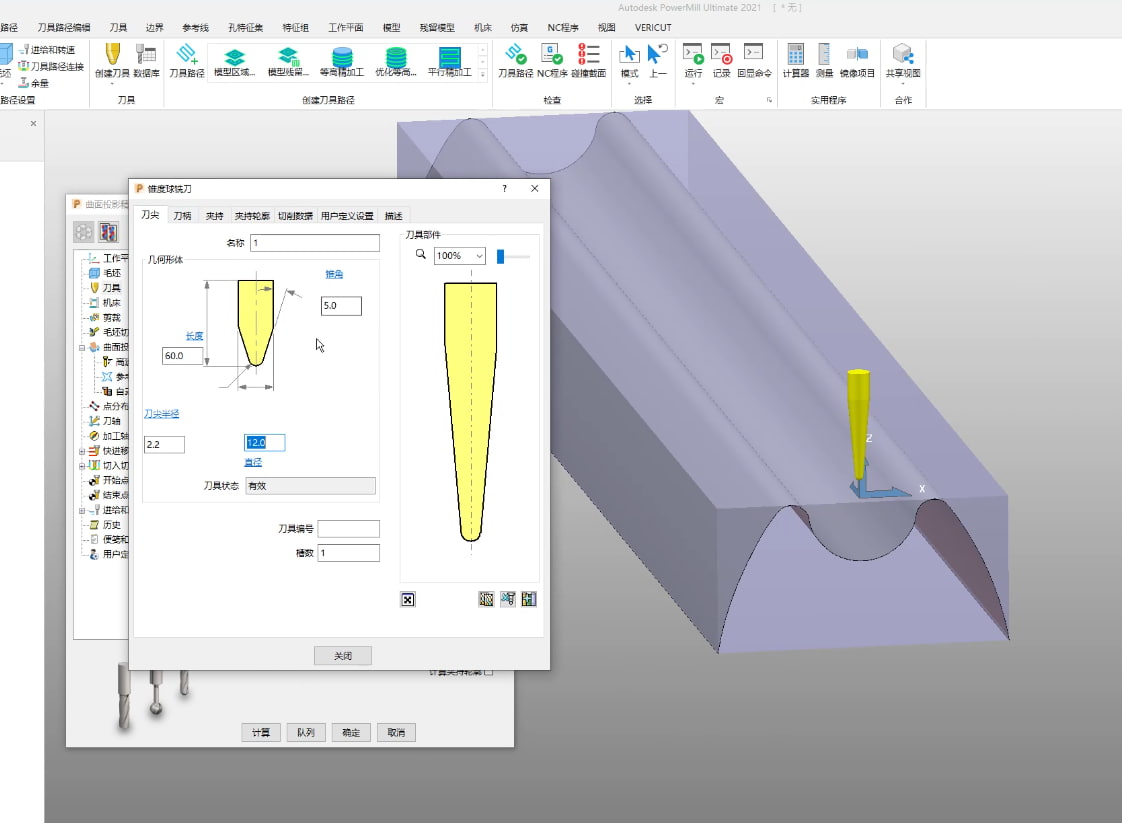
The number of physical axes is only part of the equation. The CAD/CAM system must also be capable of generating suitable toolpaths for the machine.
For example:
For complex 3D stone carving, programming and simulation become increasingly important because tool orientation, collision avoidance and machining strategy all affect the final result.
Final Takeaway: Choose by Geometry
There is no single axis configuration that is appropriate for every stone-processing application.
3-axis is primarily associated with flat surfaces, lettering and relief carving.
4-axis adds rotary machining and is particularly useful for columns, balusters, vases and other cylindrical or rotational products.
5-axis provides additional tool orientation for complex 3D sculptures, curved surfaces, hollow structures and advanced architectural stonework.
The best starting point is therefore not “Which machine has more axes?” but: “What stone products do I need to make?”
Once the product geometry, dimensions and production requirements are clear, the appropriate CNC configuration becomes much easier to determine.
dejar un mensaje
Escanear a WeChat :

Escanear a WhatsApp :






 Red IPv6 compatible